Please read our important disclaimers before using this content
If you've ever tried to set boundaries with someone who has narcissistic traits, you've likely experienced the confusion, frustration, and exhaustion that comes when your reasonable requests are met with rage, manipulation, or complete dismissal. You may have wondered if you're doing something wrong, if your boundaries are unreasonable, or if you're somehow failing at a basic relationship skill that seems to work with everyone else in your life.
The truth is more straightforward and more painful: boundaries with narcissists require a fundamentally different approach because you're not dealing with someone who recognizes your right to have boundaries in the first place. Understanding the full cycle of narcissistic abuse can help you recognize why traditional boundary-setting advice consistently backfires.
This article provides evidence-based guidance on what works (and what absolutely doesn't) when setting boundaries with individuals who exhibit narcissistic personality patterns.
What Are Boundaries? Clinical Foundation
Before addressing narcissistic dynamics specifically, let's establish what boundaries actually are from a clinical psychology perspective.
Boundaries are the physical, emotional, mental, and spiritual limits you establish to protect yourself from being manipulated, used, or violated by others. They define where you end and another person begins. Healthy boundaries allow you to maintain your sense of self, protect your wellbeing, and engage in relationships without losing yourself in the process (Cloud & Townsend, 1992).
The Purpose of Boundaries
In healthy relationships, boundaries serve several critical functions:
- Self-protection: Preventing physical, emotional, or psychological harm
- Identity maintenance: Preserving your sense of self separate from others
- Responsibility clarification: Defining what is and isn't your responsibility
- Emotional regulation: Managing your emotional responses to others' behavior
- Relationship health: Creating conditions for mutual respect and reciprocity
- Resource protection: Safeguarding your time, energy, money, and attention
Types of Boundaries
Clinical frameworks identify several distinct boundary categories (Katherine, 2000):
Physical boundaries relate to your body, personal space, privacy, and physical safety. These include who can touch you, how, when, and where; your need for personal space; and your right to physical safety and comfort.
Emotional boundaries protect your emotional wellbeing and identity. They include the right to your own feelings, the ability to separate your emotions from others', and protection from emotional manipulation or guilt trips.
Time boundaries govern how you allocate your time and energy. They protect you from over-commitment, ensure time for self-care and rest, and establish that your time has value.
Energy boundaries recognize that emotional labor, mental processing, and psychological management all consume energy. These boundaries protect you from being drained by others' constant crises, emotional regulation needs, or demands for attention.
Financial boundaries protect your economic resources and financial decision-making. They establish that you control your own money, aren't responsible for others' financial mistakes, and can make spending decisions aligned with your values.
Sexual boundaries define your comfort levels with physical intimacy, sexual activity, and sexual communication. They protect your right to enthusiastic consent, to refuse unwanted sexual contact, and to establish the terms of sexual relationships.
Information boundaries govern what personal information you share, with whom, and under what circumstances. They protect your privacy, your right to confidentiality, and your control over your own narrative.
In healthy relationships, these boundaries are generally respected. You state a boundary, the other person may feel disappointed or need to negotiate specific details, but ultimately they accept your right to set the boundary. The relationship continues with the boundary in place.
With narcissistic individuals, this process breaks down entirely.
Why Narcissists Violate Boundaries: The Clinical Reality
Understanding why narcissists consistently violate boundaries requires grasping several core features of narcissistic personality organization.
Lack of Empathy and Perspective-Taking
Neuroimaging research demonstrates that individuals with Narcissistic Personality Disorder (NPD) show reduced activity in brain regions associated with empathy and perspective-taking, particularly the anterior insula and medial prefrontal cortex. This isn't a choice to ignore your feelings—it's a neurobiological deficit in processing others' emotional experiences as real and important.
When you express that a behavior hurts you, a person with intact empathy can imagine your pain and feel motivated to avoid causing it. A narcissist may intellectually understand you're claiming to be hurt, but cannot genuinely access the emotional resonance that would motivate behavioral change.
Boundaries as Narcissistic Injury
From the narcissist's perspective, your boundary represents a threat to their grandiose self-image and control. Clinical frameworks (Kernberg, 1975; Kohut, 1977) explain that narcissistic individuals maintain psychological stability through a fragile, inflated self-concept that requires external validation and control.
When you set a boundary, you're essentially saying: "Your needs/wants/preferences end where my autonomy begins." This message triggers what clinicians call "narcissistic injury"—a blow to the inflated self-image that feels psychologically devastating to the narcissist. The rage, manipulation, or punishment that follows isn't about the specific boundary content. It's about the narcissistic injury your boundary inflicted.
Boundaries Interfere with Supply Acquisition
As discussed in research on narcissistic supply dynamics, individuals with narcissistic traits require continuous external validation (attention, admiration, emotional reactions) to maintain their self-image. Your boundaries interfere with their ability to extract this supply from you.
When you say "Don't call me after 9pm" or "I won't discuss my personal life with you," you're cutting off supply channels. The narcissist's violation of these boundaries isn't personal stubbornness—it's supply-seeking behavior. Your angry response to the 10pm phone call, your frustrated explanation of why you won't answer personal questions—these reactions are the actual goal. The boundary violation is the tool to provoke them.
Entitlement and Grandiosity
The DSM-5 diagnostic criteria for NPD include "a sense of entitlement" and "interpersonal exploitation". This isn't casual selfishness—it's a core feature of the personality structure.
The narcissist genuinely believes they are entitled to access you, your time, your emotional labor, and your compliance. Your boundary directly contradicts this entitlement. From their perspective, you're not setting a reasonable limit—you're unfairly withholding something they deserve.
What Doesn't Work: Common Boundary Mistakes
Before addressing effective strategies, let's examine why traditional boundary-setting approaches fail with narcissistic individuals.
Mistake #1: Expecting Respect for Your Boundaries
What healthy relationships look like: "I need you to call before stopping by." → "Okay, I'll text first next time."
What happens with narcissists: "I need you to call before stopping by." → They show up unannounced the next day, claiming they "forgot" or "it was an emergency" or "you're being ridiculous about a simple visit."
Why it fails: You're operating from the assumption that the person recognizes your right to set boundaries. Narcissists fundamentally do not accept this premise. Your boundary isn't something to respect—it's an obstacle to overcome or a challenge to defeat.
Mistake #2: Over-Explaining (JADE: Justify, Argue, Defend, Explain)
What it looks like: "I can't talk right now because I have a work deadline, and I've been really stressed, and I need to focus, and last time we talked it went long and I was up late, and I really need to get this done..."
Why it fails: Every justification you provide becomes ammunition for argument:
- "Your work can wait; this is important."
- "You're always too stressed; maybe you're doing something wrong."
- "I won't keep you long this time."
- "You're being selfish prioritizing work over family."
The narcissist uses your explanations to identify pressure points, craft counter-arguments, and locate exactly which justification to attack to make you doubt yourself. More importantly, by justifying, arguing, defending, and explaining, you're implicitly communicating that you need their permission to have the boundary. You don't.
Mistake #3: Negotiating Non-Negotiables
What it looks like:
- Narcissist: "I'm coming to your house for Thanksgiving."
- You: "I've told you we're not hosting this year."
- Narcissist: "What if I just come for dessert? What if I bring the whole meal? What if I promise to leave early?"
- You: "Well... I guess if it's just for an hour..."
Why it fails: The negotiation process itself demonstrates that your "no" isn't actually final. You've taught them that persistence, escalation, or finding the right angle will eventually wear you down. Additionally, you're accepting the premise that your boundary is up for debate rather than a statement of fact.
Mistake #4: Inconsistent Enforcement
What it looks like:
- Week 1: "Don't call me at work." You don't answer work calls from them.
- Week 2: They call at work claiming an "emergency." You answer. The "emergency" is that they can't find their keys.
- Week 3: They call at work. You answer "just this once."
Why it fails: Behavioral psychology research demonstrates that intermittent reinforcement (sometimes getting the desired outcome) creates stronger, more persistent behavior than consistent reinforcement. When you enforce your boundary inconsistently, you're training the narcissist to escalate, persist, and push harder because they've learned that your boundary will eventually break.
Mistake #5: Seeking Validation or Agreement
What it looks like: "You understand why I need this boundary, right? It's reasonable, isn't it? Don't you think anyone would need this?"
Why it fails: You're placing the narcissist in the position of authority over whether your boundary is "valid." If they say "no, that's unreasonable," what then? The boundary's legitimacy doesn't depend on their agreement. By seeking their validation, you've communicated that it does.
Mistake #6: Believing the False Apology
What it looks like:
- You: "I told you not to share my personal information with others."
- Narcissist: "You're right, I'm so sorry, I wasn't thinking, it won't happen again."
- [Two weeks later, they've shared even more private information]
Why it fails: The apology is part of the manipulation cycle, not genuine accountability. Research on narcissistic behavior patterns shows that apologies often serve to regain access and control rather than represent true remorse or behavioral change intention (Bushman & Baumeister, 1998). The narcissist has learned that "I'm sorry" is the phrase that gets you to drop your boundary and re-engage.
Mistake #7: Explaining the Impact
What it looks like: "When you call me 10 times in a row, I feel anxious and disrespected, and it makes my workday incredibly stressful, and I can't concentrate, and then I'm up worrying all night..."
Why it fails: You're providing the narcissist with a detailed map of exactly how to hurt you. Your vulnerability isn't met with empathy and behavioral change—it's weaponized. The next time they want a strong reaction from you, they now know precisely which buttons to push.
What Does Work: Boundaries for You, Not Them
The paradigm shift required for effective boundaries with narcissists is this: You're not setting boundaries to change their behavior. You're setting boundaries to protect yourself regardless of their behavior.
Strategy #1: No Explanations, No JADE
What it looks like:
- Narcissist: "Why can't you meet tomorrow?"
- You: "That doesn't work for me."
- Narcissist: "But why?"
- You: "It doesn't work for me."
- Narcissist: "That's not a reason!"
- You: [No response, or repeat:] "It doesn't work for me."
Why it works: You're not providing ammunition for argument. You're stating a fact. Your calendar, your energy, your decisions are not up for debate. The discomfort you feel at their dissatisfaction is temporary and manageable. The ongoing violation of your boundaries is not.
Strategy #2: Gray Rock Method
The gray rock method, developed by trauma recovery specialists, involves making yourself as uninteresting and unrewarding as possible—like a gray rock (Smith, 2011). You can find a detailed breakdown of this approach in our guide to gray rock communication strategies.
What it looks like:
- Narcissist: "I can't believe you're being so difficult about this! What's wrong with you?"
- You: "Hmm."
- Narcissist: "Don't you have anything to say for yourself?"
- You: "I've said what I need to say."
- Narcissist: "You're impossible!"
- You: "Okay." [End interaction]
Why it works: Gray rock deprives the narcissist of the emotional reaction they're seeking (narcissistic supply). Your anger, your tears, your detailed explanations—all of these fuel them. Your bland, boring, emotionally neutral responses do not. Initially, expect an "extinction burst" (increased attempts to provoke you), but if you maintain gray rock consistently, they'll redirect efforts to more responsive targets.
Gray rock essentials:
- Minimal emotional expression
- Brief, factual responses only
- No personal information shared
- No engagement with provocations
- Delay responses (don't reply instantly)
- Stick to logistics, never engage on emotional content
Strategy #3: Physical Distance and No Contact
When legally and practically possible, physical distance or complete no contact represents the most effective boundary.
What it looks like: Blocking all communication channels, refusing in-person meetings, using intermediaries for necessary legal/financial communications, moving to a new location unknown to the narcissist.
Why it works: You cannot violate a boundary with someone you cannot access. No contact eliminates the narcissist's ability to extract supply from you, manipulate your emotions, or wear down your boundaries through persistence.
No contact considerations:
- This is protection, not punishment
- Expect hoovering attempts (they'll try to re-establish contact)
- Prepare for the "extinction burst" (escalated contact attempts before they give up)
- Use legal tools if they violate no contact (restraining orders, cease-and-desist letters)
- Block flying monkeys (people who carry messages or information between you)
Strategy #4: Legal and Structural Boundaries
With narcissistic ex-partners, particularly in co-parenting situations, legal documents become your boundaries.
What it looks like:
- Court orders specifying custody schedules, exchange locations, communication methods
- Restraining orders preventing contact
- Court-approved communication apps like TalkingParents or OurFamilyWizard that create unalterable records
- Legal consequences for boundary violations
Why it works: The narcissist may not respect you, but they often respond to legal consequences. A court order isn't a request—it's a legal requirement with enforcement mechanisms. When they violate it, you have documentation and legal recourse.
Strategy #5: Consequences, Not Threats
What it looks like:
- Threat: "If you show up unannounced again, I'm going to call the police!"
- Consequence: [They show up unannounced. You call the police. No warning, no explanation.]
Why it works: Threats give the narcissist another opportunity to manipulate, argue, or test whether you're serious. Consequences teach them that boundary violations have immediate, predictable results. You've shifted from trying to control their behavior to controlling your response to their behavior.
Implementing consequences:
- Determine consequences in advance (when you're calm, not reactive)
- Make consequences realistic and enforceable
- Follow through every single time
- Don't announce consequences ahead of time
- Don't accept excuses or apologies as substitutes for changed behavior
Strategy #6: Information Diet
What it looks like: You share no personal information—about your life, your feelings, your plans, your struggles, your successes. Every interaction is strictly limited to necessary logistics.
Why it works: Information is ammunition. Every detail you share about your new job, your dating life, your vacation plans, your health issues—all of it can and will be weaponized. Additionally, sharing creates the appearance of intimacy and relationship, which the narcissist will exploit.
Information diet in practice:
- "How are you?" → "Fine."
- "What did you do this weekend?" → "Not much."
- "Are you seeing anyone?" → "That's personal."
- "Where are you living now?" → "I'm settled."
Co-Parenting Boundaries: Special Considerations
Co-parenting with a narcissistic ex-partner creates unique boundary challenges because you cannot implement full no contact while sharing children.
The Court Order as Your Boundary
Reality: Your custody agreement and parenting plan are not suggestions—they are your boundaries in legal form.
Implementation:
- The court order specifies exchange times and locations → You are there exactly at that time and location, not a minute early or late
- The order specifies communication methods → You use only those methods, no exceptions
- The order defines decision-making authority → You make decisions within your authority without seeking their input or permission
Why it matters: Every deviation you allow ("Can we swap weekends?" "Can I pick them up at your house instead?" "Can we just text instead of using the app?") teaches the narcissist that the court order is negotiable and your enforcement is inconsistent.
Parallel Parenting, Not Co-Parenting
Co-parenting requires cooperation, communication, flexibility, and shared decision-making. It assumes both parents prioritize the children's wellbeing over personal conflicts.
Parallel parenting recognizes that high-conflict co-parents cannot cooperate productively. The parallel parenting framework was developed specifically for situations where attempts at cooperative co-parenting only give the narcissist more opportunities to manipulate and control. Each parent operates independently within their own household, with minimal communication and clearly delineated decision-making authority (Eddy, 2006).
Parallel parenting boundaries:
- Each household has its own rules (bedtimes, screen time, discipline approaches)
- Day-to-day decisions are made by the parent who has the children at that time
- Communication is strictly limited to children's health, safety, and logistics
- Major decisions follow the court order's framework for decision-making authority
- You don't negotiate, explain, or defend your parenting choices
Communication Boundaries in Co-Parenting
BIFF Method (Brief, Informative, Friendly, Firm) provides a research-backed framework for high-conflict communication (Eddy, 2011):
Brief: 2-5 sentences maximum Informative: Focuses only on necessary facts Friendly: Professional, neutral tone (not personal or warm, but not hostile) Firm: Doesn't invite debate or extended discussion
Example:
-
❌ "I can't believe you're doing this again. Every single time we have an exchange you try to change the schedule at the last minute. This is exactly why we got divorced. You never respect anyone's time but your own. The kids are confused and I'm frustrated. We need to stick to the schedule that's in the court order."
-
✅ "The exchange time is 6pm Friday at the library as specified in the court order. I'll see you then."
Exchange Protocols
Boundary challenge: Custody exchanges provide opportunities for conflict, manipulation, and boundary violation.
Protective protocols:
- Public locations (McDonald's playplace, police station parking lot, library)
- Precise times (not "Friday evening"—"Friday at 6:00pm")
- Minimal interaction (children move between cars, no extended conversations)
- Third-party exchanges (relative, friend, or professional supervisor transfers children if direct exchange triggers conflict)
- Documentation (use court app for all schedule confirmations, modifications, conflicts)
What to Expect: Boundary Violations as Testing
Narcissistic co-parents routinely test boundaries to:
- Reassert control
- Provoke emotional reactions (supply)
- Demonstrate that your boundaries don't constrain them
- Create opportunities for conflict (which provides drama supply and potential legal ammunition)
Common violations:
- Late arrivals/early arrivals for exchanges
- Asking children to carry messages
- Excessive communication attempts
- Refusing to follow court-ordered communication methods
- Making unilateral decisions about children's activities, school, medical care
- Sharing inappropriate information about you with children
- Interrogating children about your household
Your response: Document, enforce consequences, don't engage emotionally. Every violation is recorded. Repeated violations become evidence for court modification of custody or communication orders.
Boundary Violations: Patterns to Expect
When you implement boundaries with a narcissistic individual, specific predictable patterns emerge.
Escalation and Extinction Burst
Initially, boundary violations often intensify. Behavioral psychology research shows that when a previously rewarded behavior (boundary violation that got them access to you) stops producing rewards (your engagement), the person escalates the behavior before eventually abandoning it.
What escalation looks like:
- More frequent contact attempts
- More dramatic "emergencies"
- Involvement of third parties (flying monkeys)
- Threats or ultimatums
- Sudden apologies or promises to change
Why it happens: The narcissist is cycling through their manipulation toolkit trying to find the tactic that breaks your boundary.
Your response: This is evidence your boundary is working. Maintain consistency through the extinction burst, and the behavior will eventually redirect to easier targets.
Smear Campaigns
When you successfully maintain boundaries, narcissists often launch "smear campaigns"—spreading false or distorted information about you to mutual friends, family members, or in legal contexts.
Why it happens:
- Narcissistic injury (your boundary wounded their self-image)
- Preemptive reputation management (discrediting you before you expose their behavior)
- Recruitment of flying monkeys (people who will pressure you to drop boundaries)
- Supply acquisition (sympathy from others)
Your response:
- Don't defend yourself to every person who hears their narrative
- Identify your "safe people" who know the truth
- Document false allegations (especially important for legal/custody contexts)
- Let your consistent behavior speak for itself over time
Hoovering Attempts
"Hoovering" (named after the vacuum cleaner brand) describes attempts to suck you back into relationship/contact after you've established distance (Durvasula, 2019).
Common hoovering tactics:
- Apology hoover: "I've been in therapy, I've changed, please give me another chance"
- Emergency hoover: Sudden crisis requiring your specific help
- Nostalgia hoover: "Remember when we..." messages
- Gift hoover: Flowers, presents, grand gestures
- Guilt hoover: "The kids miss having us together" / "I'm struggling without you"
Why it happens: You were a valuable supply source. They're attempting to reopen that supply channel.
Your response: Maintain no contact or gray rock. Do not respond to hoovering attempts, as any response (even "leave me alone") teaches them that this method gets a reaction.
Protecting Your Boundaries: Practical Strategies
Implementing boundaries is one thing; protecting them long-term requires specific supports.
Build a Support System
Why it matters: Boundary maintenance is emotionally difficult. You need people who:
- Validate that your boundaries are reasonable
- Hold you accountable to maintaining them
- Provide reality checks when you're doubting yourself
- Offer practical support during escalation periods
Support system components:
- Trauma-informed therapist experienced in narcissistic abuse
- Support group (in-person or online) for survivors
- "Safe people" in your personal life who understand the dynamics
- Legal support (attorney if custody/divorce involved)
- Crisis contacts for moments you're tempted to break no contact
Legal Tools and Documentation
Restraining orders: Legal protection when harassment, threats, or stalking occur. Violation carries criminal consequences.
Cease-and-desist letters: Formal legal notice demanding they stop specific behaviors (contact attempts, social media posts about you, showing up at your workplace).
Court-approved communication apps: Create unalterable records of all communications, with timestamps and read receipts. Admissible in court.
Documentation journal: Date, time, description of boundary violations, witnesses, evidence. Essential for legal proceedings.
Police reports: File reports for violations of restraining orders, harassment, trespassing, theft, vandalism. Creates legal record.
Safety Planning
If the narcissist has history of violence, threats, or escalation, safety planning is critical.
Safety plan components:
- Secure location they don't know about (if you need to leave quickly)
- Important documents stored securely (birth certificates, financial records, court orders)
- Emergency contacts programmed into phone
- Safety code word with trusted friends/family
- Evidence of threats/violence documented and stored safely
- Legal protection (restraining order) if appropriate
- Children prepared with age-appropriate safety information
Resource: The National Domestic Violence Hotline (1-800-799-7233) provides safety planning assistance.
Recovery Perspective: Rebuilding Boundary Muscles
Long-term narcissistic abuse often erodes your ability to recognize, set, and maintain boundaries. Recovery involves rebuilding these capacities. This connects directly to the work of healing from the fawn trauma response—the people-pleasing survival mechanism that makes boundary-setting feel dangerous even after you're safe.
Rebuilding Self-Trust
The damage: Gaslighting, manipulation, and persistent boundary violations teach you to doubt your own perceptions and judgment.
The healing:
- Start with small, low-stakes boundaries (saying no to minor requests from safe people)
- Notice when your body signals discomfort (this is your internal boundary detector)
- Validate your own feelings ("I feel uncomfortable, and that feeling is real and important")
- Track boundary successes (journal about times you maintained boundaries)
- Work with trauma-informed therapist on Internal Family Systems or Somatic Experiencing approaches
Learning to Tolerate Discomfort
The challenge: Boundary maintenance with narcissists creates discomfort—their anger, your guilt, the extinction burst escalation, the fear of retaliation.
The skill: Distinguishing between discomfort (unpleasant but manageable) and danger (genuine threat requiring different response).
The practice:
- Notice your physical response to boundary maintenance (anxiety, guilt, fear)
- Name the feeling without judgment ("This is guilt. Guilt is uncomfortable but not dangerous.")
- Remind yourself why the boundary exists ("This protects my wellbeing")
- Use distress tolerance skills (DBT strategies, grounding techniques, breathwork)
- Celebrate maintaining boundaries despite discomfort
Saying No as a Complete Sentence
The pattern to unlearn: "No" followed by justification, apology, or extensive explanation.
The pattern to develop: "No." [Full stop.]
Practice progression:
- "No, thank you."
- "No."
- "That doesn't work for me."
- [No response to unreasonable requests]
Why it's difficult: You've been trained that "no" requires justification and is subject to negotiation. Narcissists punished unexplained "no" with guilt trips, rage, or silent treatment.
Why it's essential: "No" is a complete sentence. You don't owe explanations for protecting yourself.
Case Examples: Boundaries in Action
Case Example 1: Effective Boundary in Co-Parenting Context
Background: Sarah shares custody of two children (ages 6 and 8) with narcissistic ex-husband Tom. Tom routinely calls/texts 15-20 times per day about trivial matters, often including criticism of Sarah's parenting.
Boundary implemented:
- Sarah informs Tom (via the court-ordered communication app) that communication will be limited to the app only, no phone calls except emergencies involving children's immediate health/safety
- Sarah defines "emergency" explicitly: injury requiring medical attention, severe illness, genuine safety threat
- Sarah stops responding to phone calls entirely
- Sarah responds to app messages once daily, only addressing logistics and children's needs
Tom's response: Escalation. Calls increase to 30+ per day. Leaves voicemails claiming "emergencies" (child forgot homework, child wants to talk to Sarah, child is crying for her). Sends flying monkeys (his mother) to tell Sarah she's being "unreasonable" and "hurting the children."
Sarah's maintenance:
- Documents every call/voicemail (screenshots of call log)
- Does not respond to any calls or flying monkeys
- Responds to legitimate app messages using BIFF method
- After 3 weeks of consistency, calls decrease to 2-3 per day
- After 2 months, Tom primarily uses the app
Outcome: Tom learned that phone harassment doesn't produce engagement. Sarah protected her peace, modeled healthy boundaries for children, and created documented evidence of his harassing behavior for potential future court use.
Case Example 2: Ineffective Boundary Attempt
Background: Jennifer's narcissistic mother habitually criticizes her parenting, career choices, and appearance. Jennifer wants a better relationship and decides to set a boundary.
Boundary attempted: Jennifer: "Mom, I need you to stop criticizing my parenting. It hurts my feelings and damages our relationship. I'm doing my best, and I need you to respect my choices."
Mother's response: "I'm not criticizing—I'm helping! You're too sensitive. I raised you, so I think I know something about parenting. You should be grateful I care enough to give you advice."
Jennifer's response: "But you're not just giving advice—you're saying I'm doing everything wrong. Last week you said I was ruining the kids by letting them have screen time. That's not helpful, it's hurtful."
Mother's response: "Well, you ARE letting them have too much screen time. I read an article... [20-minute lecture about screen time research]."
Jennifer's response: [Frustrated, crying] "This is exactly what I mean! You can't just respect one simple boundary!"
Why this failed:
- Jennifer explained and justified (JADE), providing ammunition for argument
- She sought her mother's validation that the boundary was reasonable
- She engaged emotionally, providing narcissistic supply (reaction, attention)
- She tried to convince rather than simply state and enforce
- No consequence for boundary violation—just continued discussion
What would work:
- Jennifer: "I won't discuss my parenting choices with you."
- Mother: "But I'm your mother!"
- Jennifer: "I'm not discussing this." [End conversation, leave, hang up]
- Mother: [Next interaction] "So about the kids' bedtime..."
- Jennifer: [End conversation immediately, no explanation]
- Mother: [Learns that parenting criticism = conversation ends]
Case Example 3: Co-Parenting Boundary with Legal Enforcement
Background: Michael's narcissistic ex-wife Dana routinely arrives 30-60 minutes late for custody exchanges, causing him to miss work commitments. The court order specifies exchanges at 6pm Fridays.
Boundary implemented:
- Michael informs Dana via court app: "Exchanges occur at the time specified in the court order. I will wait 15 minutes. After 15 minutes, I will leave and document the missed exchange."
- Michael arrives at exchange location at 6pm sharp
- At 6:15pm (if Dana hasn't arrived), Michael photographs the empty parking lot with timestamp, sends message via app: "Exchange time has passed. Documenting missed exchange."
- Michael leaves
- Michael files motion for contempt after 3 documented late/missed exchanges
Dana's response: Rage, claims "traffic," accuses Michael of "keeping children from her," tells mutual friends he's "unreasonable."
Michael's maintenance:
- Does not respond to Dana's emotional messages
- Responds only to logistics: "Exchange is 6pm Friday at [location] per court order"
- Documents every late arrival
- After 3 missed exchanges, files contempt motion
- Court orders Dana to comply with exchange times or face sanctions
Outcome: Dana's late arrivals stop when she faces legal consequences. Michael established that the court order isn't negotiable and he will enforce it through legal channels.
Research Foundation: What the Evidence Shows
Clinical research supports the boundary strategies outlined here:
Narcissistic personality patterns and empathy deficits: Neuroimaging studies confirm reduced empathic response in individuals with NPD (Schulze et al., 2013; Ritter et al., 2011), explaining why emotional appeals for boundary respect fail.
Intermittent reinforcement and behavioral persistence: Operant conditioning research demonstrates that inconsistent boundary enforcement creates stronger, more persistent boundary-violating behavior (Ferster & Skinner, 1957; Lerman & Iwata, 1996).
Gray rock method and supply deprivation: While not yet extensively studied in peer-reviewed literature, clinical case reports and therapist accounts support gray rock as effective strategy for reducing narcissistic engagement (Durvasula, 2019; Smith, 2011).
Parallel parenting in high-conflict divorce: Research demonstrates superior outcomes (reduced conflict, better child adjustment) when high-conflict parents use parallel parenting rather than attempting cooperative co-parenting (Eddy, 2006; Gould & Martindale, 2007).
No contact and trauma recovery: Studies on domestic abuse recovery consistently show that no contact with the abusive partner correlates with improved mental health outcomes, reduced PTSD symptoms, and faster recovery (Anderson et al., 2012; Walker, 2009).
Key Takeaways
- Boundaries with narcissists require a different paradigm: You're not setting boundaries to change their behavior—you're setting boundaries to protect yourself regardless of their behavior
- Traditional boundary approaches fail: Expecting respect, over-explaining (JADE), negotiating non-negotiables, and seeking validation all backfire with narcissistic individuals
- Effective strategies focus on your control: No explanations, gray rock method, physical distance, legal boundaries, and predetermined consequences all work because they don't require the narcissist's cooperation
- Co-parenting requires special tools: Court orders as boundaries, parallel parenting, BIFF communication, structured exchanges, and extensive documentation
- Expect predictable patterns: Escalation/extinction burst, smear campaigns, and hoovering attempts are normal responses to effective boundaries
- Legal and support structures matter: Restraining orders, court-approved apps, documentation, and trauma-informed support systems protect your boundaries when individual willpower isn't enough
- Recovery involves rebuilding boundary capacity: Self-trust, discomfort tolerance, and saying "no" without justification are skills that require practice and support
- Research supports these approaches: Evidence-based studies on narcissistic personality, behavioral conditioning, and high-conflict family dynamics validate these strategies
Setting boundaries with narcissistic individuals is fundamentally different from boundary-setting in healthy relationships. Understanding this difference—and implementing strategies designed for this specific dynamic—is essential for protecting your wellbeing, your children (if co-parenting), and your recovery. As part of that recovery, exploring what healthy relationship green flags look like can help you recalibrate your sense of what mutual respect actually feels like.
Your boundaries are not negotiable. They don't require the narcissist's agreement, understanding, or approval. They exist to protect you, and that protection is non-negotiable.
Resources
Narcissistic Abuse Support and Recovery:
- Psychology Today Therapist Finder - Find therapists specializing in narcissistic abuse
- National Alliance on Mental Illness (NAMI) - Mental health education and support
- EMDR International Association - Find certified EMDR therapists for trauma
- Greater Good Science Center - Evidence-based well-being practices
Legal Aid and Domestic Violence Support:
- National Domestic Violence Hotline - 1-800-799-7233 (SAFE) for safety planning (24/7)
- Legal Services Corporation - Find free legal aid for domestic violence cases
- WomensLaw.org - State-specific legal information
- American Bar Association Family Law Section - Find family law attorneys
Crisis Support:
- 988 Suicide & Crisis Lifeline - Call or text 988 (24/7)
- Crisis Text Line - Text HOME to 741741
- SAMHSA National Helpline - 1-800-662-4357
References
American Psychiatric Association. (2013). Diagnostic and statistical manual of mental disorders (5th ed.). Arlington, VA: American Psychiatric Publishing.
Anderson, D. K., Saunders, D. G., Yoshihama, M., Bybee, D. I., & Sullivan, C. M. (2012). Long-term trends in depression among women separated from abusive partners. Violence Against Women, 9(7), 807-838.
Bushman, B. J., & Baumeister, R. F. (1998). Threatened egotism, narcissism, self-esteem, and direct and displaced aggression: Does self-love or self-hate lead to violence? Journal of Personality and Social Psychology, 75(1), 219-229.
Cloud, H., & Townsend, J. (1992). Boundaries: When to say yes, how to say no to take control of your life. Grand Rapids, MI: Zondervan.
Durvasula, R. (2019). "Don't you know who I am?": How to stay sane in an era of narcissism, entitlement, and incivility. New York: Post Hill Press.
Eddy, B. (2006). High conflict people in legal disputes. Calgary, AB: Janis Publications.
Eddy, B. (2011). BIFF: Quick responses to high-conflict people, their personal attacks, hostile email, and social media meltdowns. Scottsdale, AZ: Unhooked Books.
Ferster, C. B., & Skinner, B. F. (1957). Schedules of reinforcement. New York: Appleton-Century-Crofts.
Gould, J. W., & Martindale, D. A. (2007). The art and science of child custody evaluations. New York: Guilford Press.
Katherine, A. (2000). Where to draw the line: How to set healthy boundaries every day. New York: Fireside.
Kernberg, O. F. (1975). Borderline conditions and pathological narcissism. New York: Jason Aronson.
Kohut, H. (1977). The restoration of the self. New York: International Universities Press.
Lerman, D. C., & Iwata, B. A. (1996). Developing a technology for the use of operant extinction in clinical settings: An examination of basic and applied research. Journal of Applied Behavior Analysis, 29(3), 345-382.
Morf, C. C., & Rhodewalt, F. (2001). Unraveling the paradoxes of narcissism: A dynamic self-regulatory processing model. Psychological Inquiry, 12(4), 177-196.
Ritter, K., Dziobek, I., Preißler, S., Rüter, A., Vater, A., Fydrich, T., ... & Roepke, S. (2011). Lack of empathy in patients with narcissistic personality disorder. Psychiatry Research, 187(1-2), 241-247.
Schulze, L., Dziobek, I., Vater, A., Heekeren, H. R., Bajbouj, M., Renneberg, B., ... & Roepke, S. (2013). Gray matter abnormalities in patients with narcissistic personality disorder. Journal of Psychiatric Research, 47(10), 1363-1369.
Smith, A. (2011). Psychopath free: Recovering from emotionally abusive relationships with narcissists, sociopaths, and other toxic people. New York: Berkley Books.
Walker, L. E. (2009). The battered woman syndrome (3rd ed.). New York: Springer Publishing.
Recommended Reading
From Clarity House Press — plus trusted books for deeper understanding

Surviving the Storm: When the Court Takes Your Children
Clarity House Press
For fathers in active high-conflict custody battles. Understand your CPTSD symptoms, begin stabilization, and build foundation for healing. 17 chapters covering recognition, symptoms, and the healing path.

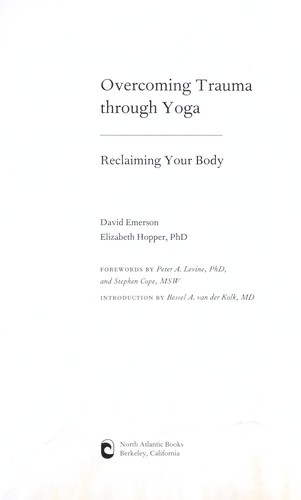
Overcoming Trauma through Yoga
David Emerson & Elizabeth Hopper, PhD
Evidence-based trauma-sensitive yoga program developed at the Trauma Center with Bessel van der Kolk.

Polyvagal Exercises for Safety and Connection
Deb Dana, LCSW
50 client-centered practices for regulating the autonomic nervous system.
As an Amazon Associate, Clarity House Press earns from qualifying purchases. Your price is never affected.
Found this helpful?
Share it with someone who might need it.
About the Author

Clarity House Press
Editorial Team
The editorial team at Clarity House Press curates and publishes evidence-based content on narcissistic abuse recovery, high-conflict divorce, and healing. Our content is informed by research, survivor experiences, and established trauma-informed approaches.
View all posts by Clarity House Press →Published by Clarity House Press Editorial Team