Skip to main content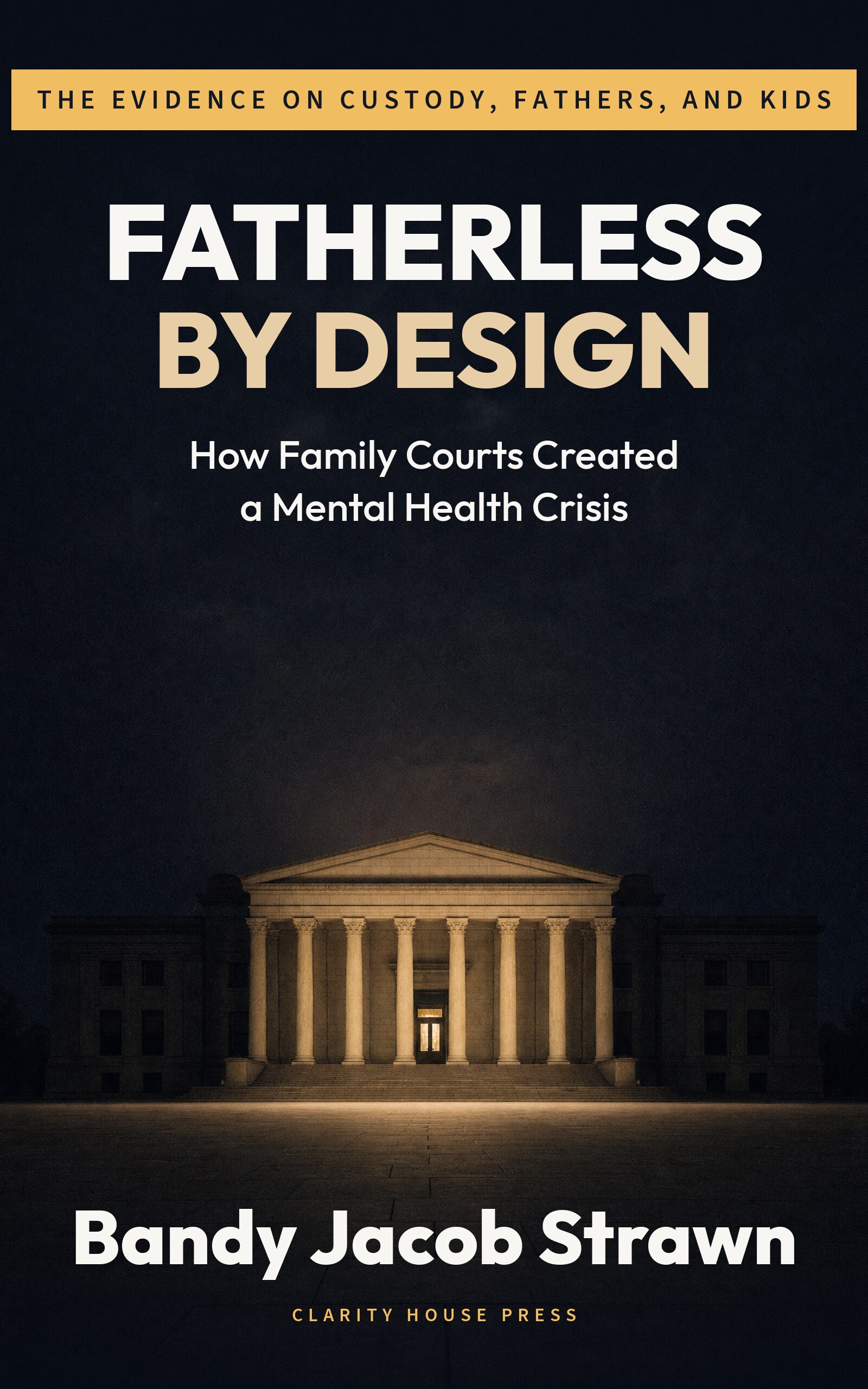
Research Report by
17.8 Million Children
One in fourAmerican childrenlive without their father
24.1% of American childrenpeak 20.6M (2012)~24M counting all father-absent arrangements
This isn’t an accident.
It’s by design.
Engineered by a family court system that treats fathers as optional—even when both parents are fit and willing. If you’ve lived it, you’re not imagining it.
The evidence, assembled.
Fourteen chapters documenting what happened to American childhood — and the system that produced it. Read the evidence free below, or start the book tonight.
- Ebook $9.99 — instant download, direct from the publisher
- Print editions — August 13, 2026
- Audiobook — 2027
Or read the evidence first
Stable for a decade. Then 2007.
Everyone blamed smartphones, social media, the pandemic. The timeline says they were looking in the wrong place.
1
2007
Historic low in youth suicide (6.8 per 100,000). Then rates begin climbing.
2
2010-2015
Depression rates double. Youth suicide rates climb. Emergency rooms overflow.
3
2018
Youth suicide up 57%from 2007. Ages 10–14: +62%.
4
2020-2023
The Surgeon General declares a national crisis. Father absence remains unmentioned.
This began before smartphones
And years before COVID-19
If you’re a father fighting for your children, you already know something is wrong. The clinical data confirms what you’ve experienced.
The Clinical Evidence
Meta-analyses of father absence show consistent patterns across mental health outcomes.
57%
Youth Suicide Increase
Ages 10-24 (2007-2018)
+62%
Ages 10–14
Suicide-rate increase (2007–2018)
42%
Persistent Sadness
High school students (CDC 2023)
Father Absence vs. Father Present
| Outcome | Father-Absent | Father-Present | Increase |
|---|---|---|---|
| Clinical Depression | 20% | 12% | +67% |
| Substance Abuse | 32% | 20% | +60% |
| Conduct Disorder | 24% | 10% | +140% |
| Suicidal Ideation | 16% | 9% | +78% |
Source: Amato (2001), Fergusson et al. (2006) meta-analyses
These aren’t small differences. Children in father-absent homes face systematically higher risks across every measured outcome.
That’s not correlation. That strongly supports causation.
This Is Not Opinion
352 peer-reviewed sources · 430+ citations — decades of science reaching the same conclusion.
352
Peer-Reviewed Sources
430+
Citations
40
Years of Research
30+
Countries Studied
The Causation Test
Bradford Hill criteria: the same standard used to prove smoking causes cancer. 5 strongly met, 4 partially met, none violated.
Read a free sample chapter
Chapter 1: “The Invisible Wound” — delivered to your inbox. No spam, unsubscribe anytime.
The harm is real. Now — what the courts actually do.
What the Courts Actually Do
The arrangement with the best evidence — shared custody — is ordered in fewer than 10% of cases. Here’s how it actually resolves.
80%
Maternal
80%
Mother Primary
~80% of children live primarily with mothers
10%
Shared Physical
Best outcomes for children — but rarely ordered
7%
Father Primary
Less common outcome
3%
Other
Split custody, third party
Source: U.S. Census Bureau, P60-269 (2020)
What “standard visitation” does to a month.
The Mathematics of Disappearance
“Every other weekend” sounds reasonable.
Here’s what it actually means.
4
Days Per Month
Standard visitation schedule
13%
Of The Year
Time with father
36
Waking Hours
Per month average
87%
Reduction
From pre-separation contact to “standard visitation”
Illustrative arithmetic: standard visitation = 4 days/month (13% of time). 100% − 13% = 87% reduction.
If that arithmetic is your life — the rest of the book is for you.
352 peer-reviewed sources, assembled into the case you've been trying to make.
Buy the ebook — $9.99The System Doesn’t Fail Everyone Equally
Black fathers face systemic barriers that compound every disadvantage.
Black Fathers
White Fathers
Children Living with Mother Only
44%
13%
Incarceration Rate (All Offenses)
5x baseline
1x baseline
CS Non-Payment Incarceration (Large Cities)
15%
5%
A 3.4× disparity that compounds across generations
Source: Federal Interagency Forum on Child and Family Statistics, 2023
Sweden Didn’t Argue About It. It Moved.
A 1998 reform made shared custody the working presumption for fit parents. Shared parenting went from rare to normal — and child outcomes followed.
23%
Sweden
Children of separated parents in shared physical custody
7%
United States
The American exception — no federal reform, state by state
Change doesn’t require new science. It requires implementing what we already know works.
The evidence exists. Now it’s a book.
Fatherless by Design
352 peer-reviewed sources · 430+ citations · 14 chapters
By Bandy Jacob Strawn
Archival edition~$94.99
Color hardcover, reference-grade — 2027
Hardcover $34.99 · Paperback $24.99
Available now on Amazon
Ebook$9.99
Start reading tonight — instant download
Audiobook
2027
Direct purchases come straight from the publisher — instant download, PDF and EPUB.