Please read our important disclaimers before using this content
This article provides general educational information about mediation strategy in high-conflict cases. This is not legal advice for your specific situation. Mediation procedures, requirements, and enforceability vary significantly by jurisdiction. Consult with a family law attorney in your state before entering mediation.
The court ordered you to mediate before trial. Or your attorney is pressuring you to "try mediation—it's cheaper than litigation." Or your ex proposed mediation and you're wondering if this is a trap or a genuine opportunity to resolve your custody dispute.
Mediation is supposed to be a cooperative alternative to adversarial litigation. A neutral mediator facilitates negotiation. You and your ex (with or without attorneys) work together to reach an agreement. Everyone wins. Everyone saves money. Everyone avoids the trauma of trial.
Except when one person demonstrates narcissistic behavior patterns who sees mediation as another opportunity to manipulate, control, gaslight, and "win" at your expense. Understanding how manipulation tactics operate in general prepares you to recognize them specifically in the mediation room. When we refer to a "narcissistic ex" throughout this article, we mean someone who consistently demonstrates narcissistic behavior patterns—whether or not they would meet clinical criteria for Narcissistic Personality Disorder.1
Can mediation work with a narcissistic ex?
It depends on the mediator's skill, the process structure, and your strategic approach. With the right safeguards, mediation can sometimes result in settlement—even with a high-conflict personality. Without safeguards, it's a waste of time and money at best, and a dangerous setup for manipulation at worst.
This is advanced strategy for protecting yourself in mediation with a narcissistic ex.
SAFETY FIRST: If you have experienced domestic violence, coercive control, or fear your ex-partner, mediation may not be safe or appropriate regardless of court requirements. Before proceeding with mediation:
- Consult with a domestic violence advocate (not just your attorney)
- Request DV screening from the court
- Explore whether you qualify for DV exception to mandatory mediation
- If mediation proceeds, insist on caucus format with safety protocols
Your safety is more important than settling the case. If mediation feels unsafe, you have the right to stop and return to court.
When Mediation Is Required
In many jurisdictions, mediation is mandatory before trial in custody cases.
Types of mandatory mediation:
1. Court-ordered mediation
- Judge orders both parties to attempt mediation before trial
- May require mediator from approved court roster
- Must file proof of attempt before trial can proceed
2. Custody mediation (required by law)
- Some states require mediation for all custody disputes
- In some states (such as California), Family Court Services or court-provided mediators handle custody disputes. Other states may use private mediators or court-approved roster mediators. Check your specific jurisdiction's requirements.
- Focus is on parenting plan, not property division
3. Contractual mediation
- Your custody order or settlement agreement requires mediation before filing motions
- Common in high-conflict cases to reduce court filings
Research indicates that mediators are generally unable to effectively detect domestic violence without the aid of validated screening devices, highlighting why specialized assessment tools are critical in high-conflict cases (Holtzworth-Munroe et al., 2021)2.
Even if mediation fails, courts often require you to try.
You cannot skip mediation (when required) unless you qualify for a domestic violence exception:
DV Exceptions to Mandatory Mediation (available in most jurisdictions):
- Active protective/restraining order against the other party
- Credible allegation of domestic violence (even without protective order)
- History of domestic violence documented through police reports, medical records, witness statements, or victim affidavit
- Safety screening indicates DV risk factors—validated instruments like the Mediator's Assessment of Safety Issues and Concerns (MASIC) assess seven types of intimate partner abuse including psychological abuse, coercive controlling behaviors, and stalking (Rossi et al., 2024)3
- Coercive control or psychological abuse that creates power imbalance (increasingly recognized)4
How to Request DV Exception:
- File declaration/affidavit with court describing DV history, include available evidence
- Request DV screening if court hasn't automatically provided one
- Cite applicable statute/court rule (your attorney can identify the specific rule in your jurisdiction)
- Request court hearing if exception is denied and you believe it should apply
CRITICAL: The COURT determines if DV exception applies, not the mediator. If the court orders mediation despite your DV concerns, you can:
- Request reconsideration with additional evidence
- Appeal the order (through attorney)
- Request caucus/shuttle mediation with safety protocols as absolute minimum
State variation note: Mediation requirements vary dramatically by state and even by county. Some states (like California) mandate custody mediation before any custody hearing. Other states only require mediation if ordered by the judge. Some states allow domestic violence victims to opt out entirely; others only allow remote/caucus participation.5 Check your state's family code or ask your attorney about local requirements.
How Narcissists Use Mediation Against You
The Narcissist's Mediation Playbook
1. Charm the mediator
- Present as reasonable, cooperative, willing to compromise
- Paint you as the difficult, high-conflict party
- Use therapy language ("I just want what's best for the kids," "I'm trying to co-parent")
2. Gaslight you
- Rewrite history ("We agreed to this," when you never did)
- Deny things that happened ("I never said that")
- Make you doubt your own memory and perception—research confirms that narcissistic traits correlate with communication patterns characterized by devaluation and manipulation in intimate relationships (Day et al., 2021)6
3. Play victim (DARVO)
This tactic—Deny, Attack, Reverse Victim and Offender—is used to reframe the abuser as the victim in mediation. Understanding how DARVO works in detail helps you recognize it without being destabilized by it.
- Claim you're alienating the children
- Say they're being shut out of children's lives
- Cry about how much they miss the kids (when they rarely exercised parenting time)
- Use "Deny, Attack, Reverse Victim and Offender" tactics—research shows this manipulation strategy influences observers to view the actual victim as less credible7
4. Propose unreasonable demands
- Start with outrageous positions to make their real demands seem moderate by comparison
- Demand things they know you'll never agree to
- Refuse to compromise on anything
5. Delay and obstruct
- Cancel sessions at last minute
- "Forget" to bring financial documents
- Refuse to engage ("I need more time to think about this")
- Drag out process to exhaust you financially and emotionally
6. Weaponize your emotions
- Provoke you until you react
- Then point to your reaction as proof you're unstable
- Stay calm themselves to look reasonable by comparison
7. Make false concessions
- Appear to agree, then back out later
- Agree in mediation, then violate the agreement
- Use agreements as ammunition ("We settled this in mediation—you're not honoring it")
8. Gather intelligence
- Use mediation to learn your legal strategy
- Probe for weaknesses in your case
- Collect information to use against you at trial
- Weaponize court processes as a continuation of coercive control—research on the Legal Abuse Scale shows abusers systematically misuse family court proceedings to maintain power over survivors8
Types of Mediation Processes
1. Joint Session Mediation
What it is:
- All parties in same room
- Mediator facilitates discussion
- You and your ex negotiate face-to-face
When it works:
- Both parties can communicate respectfully
- No history of domestic violence or intimidation
- Power balance is relatively equal
When it DOESN'T work:
- One party is narcissistic, abusive, or intimidating
- Victim is too afraid to speak honestly
- Power imbalance is too great
If you're in joint session with narcissistic ex:
- They will dominate the conversation
- You'll feel intimidated and unable to advocate for yourself
- Mediator may not see the manipulation happening
2. Caucus (Shuttle) Mediation
What it is:
- You and your ex in separate rooms
- Mediator shuttles between rooms
- No face-to-face contact
Why it's better for DV/high-conflict cases:
- You don't have to face your abuser
- You can speak honestly without intimidation
- Power imbalance is reduced9
- Mediator can control information flow
Request caucus mediation if:
- Domestic violence history
- You feel unsafe or intimidated
- You can't advocate effectively with your ex present
Most mediators will agree to caucus if you request it (especially if you cite safety concerns).
IMPORTANT LEGAL NOTE: In many jurisdictions, if mediation proceeds despite DV history, court rules or mediator standards of practice REQUIRE caucus mediation. This is not discretionary. If you have documented DV history and the mediator refuses caucus format:
- This may violate court rules or mediator ethical standards
- Document the refusal in writing
- Report to court and request different mediator
- Contact your state's mediator standards board/committee
You should not proceed with joint session mediation if you have DV history and feel unsafe. Walk away and inform the court.
3. Attorney-Assisted Mediation
What it is:
- Your attorney attends mediation with you
- Attorney can speak for you, advise you during process
Pros:
- Legal protection: Attorney ensures you don't agree to harmful terms
- Advocacy: Attorney negotiates on your behalf
- Support: You're not alone with narcissistic ex and mediator
Cons:
- More expensive: You're paying attorney hourly fees for mediation time
- May be required: Some mediators require attorneys present
If you can afford an attorney, bringing them to mediation provides significant protection. If you cannot afford this, prioritize these alternatives: attorney review of agreement after mediation, phone consultation before/after sessions, requesting caucus mediation, or seeking legal aid assistance.
4. Evaluative vs. Facilitative Mediation
Facilitative mediator:
- Helps parties communicate and negotiate
- Doesn't give opinions on who's right/wrong
- Doesn't predict what court would do
Evaluative mediator:
- Gives opinions about strengths/weaknesses of each side's case
- Predicts likely court outcome
- Pushes parties toward realistic settlement
For high-conflict cases, evaluative mediation may be more effective: Some research and mediation practitioners suggest evaluative mediation may be more effective with high-conflict parties, though outcomes depend on the mediator's skill and parties' responsiveness. Narcissists may respond to a mediator saying "a judge won't give you that," but effectiveness varies by situation. Research shows individuals with narcissistic and other Cluster B personality disorders are "the clients whom you will most see in protracted litigation or mediation" in family law contexts10. Bill Eddy's research on high-conflict personalities emphasizes that traditional mediation approaches often fail because they assume both parties can negotiate in good faith—a paradigm shift is required when mediating with individuals who demonstrate patterns of blame preoccupation, all-or-nothing thinking, and extreme behaviors (Eddy & Lomax, 2021)11.
Protecting Yourself in Mediation
Before Mediation
1. Choose the right mediator (if you have choice)
LEGAL REQUIREMENTS in DV cases (varies by jurisdiction):
- Mandatory DV training: Many states require 8-16 hours of domestic violence training for family law mediators
- Specialized DV mediator roster: Some courts maintain separate rosters of DV-trained mediators
- Certification requirements: May need additional certification beyond basic mediator training
ASK SPECIFICALLY:
- "How many hours of domestic violence training do you have?"
- "When was your last DV training update?"
- "How many DV cases have you mediated?"
- "What is your protocol for DV cases?" (Should include automatic caucus, safety planning, screening)
Look for:
- Experience with high-conflict personalities and coercive control (not just physical violence)
- Training in trauma-informed practices12
- Understanding of power imbalance dynamics—research demonstrates mediation requires balanced power between participants, while domestic violence creates profound power disparities that make traditional mediation ineffective or harmful13
- Willingness to do caucus mediation (should be automatic in DV cases, not negotiable)
- Strong boundaries (won't be charmed or manipulated)
- Evaluative style (will call out unreasonable positions)
Red flags:
- Believes "it takes two" to create conflict (doesn't recognize abuse dynamics)
- Prioritizes "keeping the peace" over safety and fair outcomes
- Minimizes DV concerns ("That was in the past," "You need to move on")
- Easily swayed by charm
- Pushes for joint sessions despite DV history
- Lacks required DV training (verify credentials)
Interview mediators before selecting (if you have choice).
2. Request caucus mediation in advance
- Email mediator before first session
- Explain you don't feel safe in joint session
- Cite domestic violence history if applicable
3. Prepare with your attorney
- Know your goals (best outcome, acceptable compromise, walk-away point)
- Identify your leverage (what do you have that they want?)
- Anticipate your ex's tactics (charm, victim-playing, unreasonable demands)
- Practice responses to manipulation
4. Gather documents
- Financial records (if discussing property/support)
- Proposed parenting plan
- Evidence supporting your position
- Communication logs showing your ex's behavior
5. Set expectations
- Mediation may not result in settlement (and that's okay)
- Your goal is to protect yourself and get fair terms (not to make peace)
- You can walk away if terms are unacceptable
During Mediation
1. Request separate rooms (caucus) if you feel unsafe
- You have the right to ask, even mid-session
2. Don't react to provocations
- Your ex may try to trigger you
- Stay calm, factual, unemotional
- Let them look unreasonable
- This is easier said than done after experiencing abuse. Your nervous system may need time to settle—consider practicing grounding techniques, and know that taking breaks is not weakness.
3. Speak truth to the mediator (in private caucus)
- Explain the abuse dynamics
- Describe your ex's manipulation tactics
- Be specific (not "he's a narcissist" but "he uses these specific behaviors")
- Note that research shows legal professionals often have poor knowledge of coercive control tactics, so you may need to educate your mediator about specific manipulation patterns14
4. Don't agree to anything out of pressure, fear, or exhaustion
- Mediators sometimes pressure parties to settle ("You're so close!")
- You can say "I need to think about this" or "I need to consult my attorney"
- You can take breaks
- Warning signs you're in these states: feeling overwhelmed, unable to think clearly, wanting it to be over, doubting your own judgment, or feeling physically frozen/activated. If you notice these signs, say "I need a break" and step away.
5. Watch for mediator bias
- Is mediator believing your ex's charm?
- Is mediator pushing you to compromise more than your ex?
- Is mediator minimizing your abuse concerns?
If mediator is biased, document it (you may need to request different mediator or explain to court why mediation failed).
6. Don't provide information your ex doesn't need
- Mediator should only share what's necessary
- If in caucus, you can ask mediator not to share certain info
7. Get everything in writing
- If you reach any agreements, get them in writing immediately
- Signed by both parties
- Filed with court (so they're enforceable)
When to Walk Away
You should terminate mediation if:
- Your ex is using it to abuse, intimidate, or manipulate you
- Mediator is biased and favoring your ex
- Your ex is negotiating in bad faith (making unreasonable demands, refusing to compromise, delaying tactics)
- You're being pressured to agree to unsafe or unfair terms
- Mediation is causing more harm than good (trauma, financial cost, no progress)
- You feel physically unsafe (intimidation, threats, fear of retaliation)
- Your ex is violating protective order by their conduct in mediation
- Mediator is requiring contact that violates safety plan (e.g., insisting on joint session despite DV)
- Your trauma responses are being triggered to extent you cannot advocate effectively
- Your ex is using mediation to continue abuse (threats, surveillance of your location, contact beyond mediation sessions)
You have the right to end mediation. Inform mediator and file statement with court that mediation was unsuccessful.
Strategic Use of Mediation
When Mediation Can Work (Even with Narcissists)
CRITICAL DISTINCTION:
- High-conflict/narcissistic personality without DV: Mediation may work with proper safeguards (caucus format, strong mediator, attorney present)
- Domestic violence (physical, sexual, coercive control): Mediation is contraindicated even with safeguards due to power imbalance and safety risks15. Recent policy reforms across multiple countries reflect this understanding—Australia now allows greater flexibility in cases involving family violence, and in January 2024, England and Wales rejected proposals for compulsory mediation specifically to protect domestic abuse survivors (Parliament of Australia, 2023; Ministry of Justice UK, 2024)16
The strategies below apply to high-conflict personalities. If you have experienced domestic violence, prioritize safety over settlement. Mediation may not be appropriate regardless of structure.
Mediation may succeed if:
1. You have strong leverage
- Your ex wants something you control (custody time, asset, waiver of support)
- You can use what they want to negotiate for what you need
2. Reality check from mediator
- Evaluative mediator tells your ex they'll lose at trial
- Your ex realizes fighting will cost more than settling
3. Your ex wants to "win" by avoiding trial
- Some narcissists view settling as "outsmarting the system"
- If you can frame settlement as their idea, they may agree
4. Attorney is present to protect you
- Attorney ensures fair terms
- Attorney handles negotiation so you don't have to engage directly
5. Process is structured to prevent manipulation
- Caucus mediation
- Firm mediator with boundaries
- Time limits (can't drag on indefinitely)
Using Mediation for Discovery
Even if mediation doesn't result in settlement, it can be useful for:
1. Learning your ex's position
- What are they demanding?
- What are their weak points?
- What are they hiding?
2. Demonstrating good faith
- You can tell the judge you tried to settle
- Your ex's unreasonableness will be documented
3. Showing your ex's behavior
- If they're hostile, unreasonable, manipulative in mediation, that helps your custody case
- Mediator may write report documenting this (in jurisdictions where mediators report to court—many states require mediation to be confidential, so ask your attorney whether the mediator will report your ex's behavior to the judge)
4. Testing settlement options
- Float proposals without committing
- See how your ex responds
ETHICAL NOTE: Mediation requires good-faith participation. While you can benefit from information learned in mediation even if settlement doesn't occur, you should not enter mediation with NO intention of settling. Most mediation agreements require good-faith participation, and courts may sanction parties who abuse the process. The above describes legitimate secondary benefits IF you genuinely attempt settlement, not strategies for using mediation purely for discovery.
Mediation Agreements: Proceed with Caution
If You Reach Agreement
Before signing:
1. Have your attorney review every term
- Don't sign in mediation session without attorney review
- Take agreement home, review carefully
- Identify any vague or problematic language
2. Ensure agreement is specific and enforceable
❌ Vague: "Parents will cooperate on school issues."
✅ Specific: "Both parents will receive copies of all school communications. Parent-teacher conferences will be scheduled separately. Each parent may attend children's school events without notification to other parent."
3. Include consequences for violations
- What happens if your ex violates the agreement?
- Build in enforcement mechanisms
4. Don't agree to unenforceable terms
- Can't agree to things court can't order (e.g., "You'll never say anything negative about me")
- Can't contract away children's rights (e.g., "Children will never need therapy")
5. Get it filed with court immediately
- Until it's a court order, it's just a contract (harder to enforce)
- File it as stipulated judgment/order
Common Agreement Traps
Watch for:
1. Waiving important rights
- Waiving spousal support when you're entitled
- Agreeing to no child support or below-guideline support without equivalent benefit to children (child support is the child's right—you can waive or reduce ONLY if children receive equivalent or greater benefit through other means, and court approves)
- Giving up custody rights you shouldn't give up
2. Vague language
- Leaves room for interpretation and future disputes
- Narcissists exploit vagueness
3. Unequal compromises
- You're giving up 80%, they're giving up 20%
- Mediator may present this as "both sides compromising" (but it's not equal)
4. Agreements you can't live with long-term
- You agree out of exhaustion, fear, or pressure
- Six months later you realize it's unworkable
Take your time. Don't sign under pressure.
Your Next Steps
If you're facing mediation with a narcissistic ex:
-
Determine if mediation is required or voluntary
-
Choose mediator carefully (if you have choice)—prioritize DV/high-conflict experience
-
Request caucus mediation in advance
-
Hire attorney to attend with you (if remotely affordable)
-
Prepare thoroughly with attorney (goals, leverage, walk-away point)
-
Set expectations realistically (mediation may not result in settlement—and that's okay)
-
Protect yourself during process (separate rooms, don't react, speak truth to mediator)
-
Don't agree to bad terms out of pressure or exhaustion
-
Walk away if necessary (you have that right)
-
If you settle, get everything in writing and filed with court immediately
Remember: Mediation is a tool, not a requirement to sacrifice your safety or your children's wellbeing. If mediation fails, parallel parenting rather than co-parenting is the appropriate framework for ongoing contact with a high-conflict ex. A fair settlement is better than trial. But an unfair settlement is worse than trial. Don't settle just to avoid conflict—settle only if the terms are genuinely acceptable and protect your children.
Your ex may have spent years manipulating you into accepting unacceptable treatment. Mediation is not the time to continue that pattern. For guidance on what to do if court orders reached in mediation are later violated, enforcing custody order violations through contempt proceedings is your next resource.
Resources
Mediation and Mediator Directories:
- Academy of Professional Family Mediators - Find domestic violence-informed mediators
- Association for Conflict Resolution - Mediator directory and credentials verification
- American Academy of Matrimonial Lawyers - Find family law attorneys who can attend mediation with you
- National Conflict Resolution Center - Mediation services and mediator training resources
Domestic Violence Safety and Legal Information:
- National Domestic Violence Hotline - 1-800-799-7233 (SAFE) for safety assessment before mediation
- WomensLaw.org - State-specific mediation laws and domestic violence exemptions
- National Center on Domestic Violence, Trauma & Mental Health - Mediation safety resources
- Family Violence Appellate Project - Legal support for mediation safety motions
Crisis Support and Co-Parenting Resources:
- 988 Suicide & Crisis Lifeline - Call or text 988 for crisis support during mediation (24/7)
- Crisis Text Line - Text HOME to 741741 for crisis counseling
- OurFamilyWizard - Documented communication to avoid unsafe direct contact
- Legal Services Corporation - Find free/low-cost legal aid for mediation representation
References
References
- Centers for Disease Control and Prevention. (2022). The National Intimate Partner and Sexual Violence Survey 2016/2017: Report on Intimate Partner Violence. The CDC defines intimate partner violence (IPV) as physical violence, sexual violence, stalking and psychological aggression (including coercive control and narcissistic behavior patterns) by a current or former intimate partner. ↩
- North Dakota Court System. Mediator Domestic Violence Screening Tool and Safety Planning. Courts use standardized screening tools to assess domestic violence risk factors, with mediators responsible for ongoing screening throughout all phases of mediation and terminating mediation if either party is unable to mediate safely. ↩
- Centers for Disease Control and Prevention. (2022). About Intimate Partner Violence. Coercive control encompasses behaviors whose purpose is to monitor, control, or threaten an intimate partner and is recognized as a component of psychological aggression within intimate partner violence. ↩
- National Institute of Justice. Divorce Mediation and Domestic Violence. Research shows that mediation techniques must be adjusted to address domestic abuse dynamics, notably by equalizing the power of the abuser and the victim in the mediation process. Power balance can be facilitated by requiring separate counseling, beginning mediation by meeting separately with parties (caucus format), and using advocates to represent each party. ↩
- Substance Abuse and Mental Health Services Administration. Trauma-Informed Approaches and Programs. SAMHSA defines trauma-informed care as involving key elements: (1) realizing the prevalence of trauma; (2) recognizing how trauma affects all individuals involved; and (3) responding by putting this knowledge into practice to prevent re-traumatization. ↩
- National Institute of Justice. Mandatory Divorce Custody Mediation and Intimate Partner Violence. NIJ-funded research identified intimate partner violence (IPV) in 59% of mediation cases. Higher levels of IPV were associated with lower likelihood of reaching agreement, and parties with sufficient likelihood of domestic violence are typically screened out as unsuitable for mediation due to safety and power imbalance concerns. ↩
- Harvard Negotiation Law Review. (2021). Addressing Domestic Violence in Mediation: The Need for More Uniformity and Research. State mediation programs create domestic violence exceptions using three general methods: (1) bar with waiver (requiring formal consent), (2) good cause bar (requiring showing of good cause), or (3) total bar (complete prohibition following DV showing). Rules vary widely between jurisdictions. ↩
- Harsey, S. J., Zurbriggen, E. L., & Freyd, J. J. (2017). Perpetrator Responses to Victim Confrontation: DARVO and Victim Self-Blame. Journal of Aggression, Maltreatment & Trauma, 26(6), 644-663. DOI: 10.1080/10926771.2017.1320777. Research shows that when perpetrators use DARVO tactics (Deny, Attack, Reverse Victim and Offender), victims report increased self-blame and observers perceive the actual victim as less credible. ↩
- Johnson, M., Gibbons, E., & Sullivan, C. (2022). Coercive Control in the Courtroom: the Legal Abuse Scale (LAS). Journal of Family Violence, 38(3), 441-453. DOI: 10.1007/s10896-022-00403-9. The 14-item Legal Abuse Scale (LAS) measures systematic misuse of family court proceedings by abusers to enact coercive control against survivor-mothers, including weaponizing custody disputes and financial proceedings. ↩
- Heller, M., & Gath, I. (2013). Disorder in the Court: Cluster B Personality Disorders in United States Case Law. Journal of the American Academy of Psychiatry and the Law, 41(4), 542-549. Analysis of U.S. case law shows individuals with narcissistic and other Cluster B personality disorders (borderline, antisocial, histrionic) are the clients most frequently seen in protracted family law litigation and mediation. ↩
- Maxwell, M. S. (1999). Mandatory Mediation of Custody in the Face of Domestic Violence. Family Court Review, 37(3), 335-355. DOI: 10.1111/j.174-1617.1999.tb01309.x. Research demonstrates mediation requires balanced power between participants, while domestic violence creates profound power disparities that undermine victims' ability to negotiate safely and effectively. ↩
- Ellis, S., O'Brien, K., & Monk, S. (2024). The psychological impact on mothers who have experienced domestic violence when navigating the family court system: a scoping review. Trauma, Violence, & Abuse, DOI: 10.1177/15248380241270506. Systematic review identified poor knowledge of coercive control tactics among legal professionals as a key barrier, with survivors reporting perpetrators successfully using the system for continued control and secondary victimization. ↩
- Day, N. J., Townsend, M. L., & Grenyer, B. F. (2021). Living with pathological narcissism: A qualitative study. Personality and Individual Differences, 169, 110560. DOI: 10.1016/j.paid.2020.110560. Research examining partners of individuals with narcissistic traits found communication patterns characterized by idealization-devaluation cycles, gaslighting, and manipulation, with participants reporting significant psychological distress from these dynamics. ↩
- Holtzworth-Munroe, A., Beck, C. J., & Applegate, A. G. (2021). Addressing Domestic Violence in Mediation: The Need for More Uniformity and Research. Harvard Negotiation Law Review. Analysis found that mediators are generally unable to effectively detect domestic violence without validated screening instruments, highlighting the need for standardized screening protocols across jurisdictions. ↩
- Rossi, F. S., Holtzworth-Munroe, A., Applegate, A. G., & Beck, C. J. (2024). Intimate partner violence screening for separating or divorcing parents: An introduction to the Mediator's Assessment of Safety Issues and Concerns-Short (MASIC-S). Family Court Review, 62(1). The MASIC-S assesses seven types of intimate partner abuse—psychological abuse, coercive controlling behaviors, threats, physical violence, severe physical violence, sexual violence, and stalking—with confirmatory factor analysis demonstrating excellent internal consistency. ↩
- Eddy, B., & Lomax, M. (2021). Mediating High Conflict Disputes: A Radical New Model with Tips, Tools and the New Ways for Mediation Method. Unhooked Books. The authors define high-conflict personality patterns as characterized by preoccupation with targets of blame, all-or-nothing thinking, unmanaged emotions, and extreme behaviors—requiring mediators to shift from traditional facilitative approaches to structured methods that manage rather than resolve underlying personality dynamics. ↩
- Ministry of Justice, UK. (2024). Supporting earlier resolution of private family law arrangements: Government response. Following the January 2024 consultation, the UK government rejected compulsory mediation in family law cases, expanding instead the Pathfinder pilot program to improve outcomes for domestic abuse survivors while maintaining voluntary mediation pathways. ↩
Recommended Reading
From Clarity House Press — plus trusted books for deeper understanding


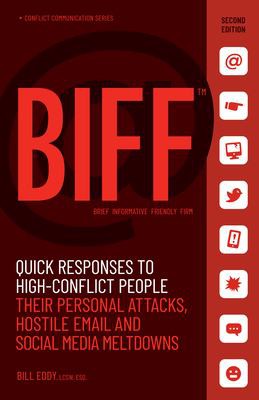
BIFF: Quick Responses to High-Conflict People
Bill Eddy, LCSW Esq.
Brief, Informative, Friendly, and Firm responses for dealing with high-conflict people.

5 Types of People Who Can Ruin Your Life
Bill Eddy
Identifies five high-conflict personality types and teaches how to spot warning signs.
As an Amazon Associate, Clarity House Press earns from qualifying purchases. Your price is never affected.
Found this helpful?
Share it with someone who might need it.
About the Author

Clarity House Press
Editorial Team
The editorial team at Clarity House Press curates and publishes evidence-based content on narcissistic abuse recovery, high-conflict divorce, and healing. Our content is informed by research, survivor experiences, and established trauma-informed approaches.
View all posts by Clarity House Press →Published by Clarity House Press Editorial Team