Loading books
Releases November 11, 2026
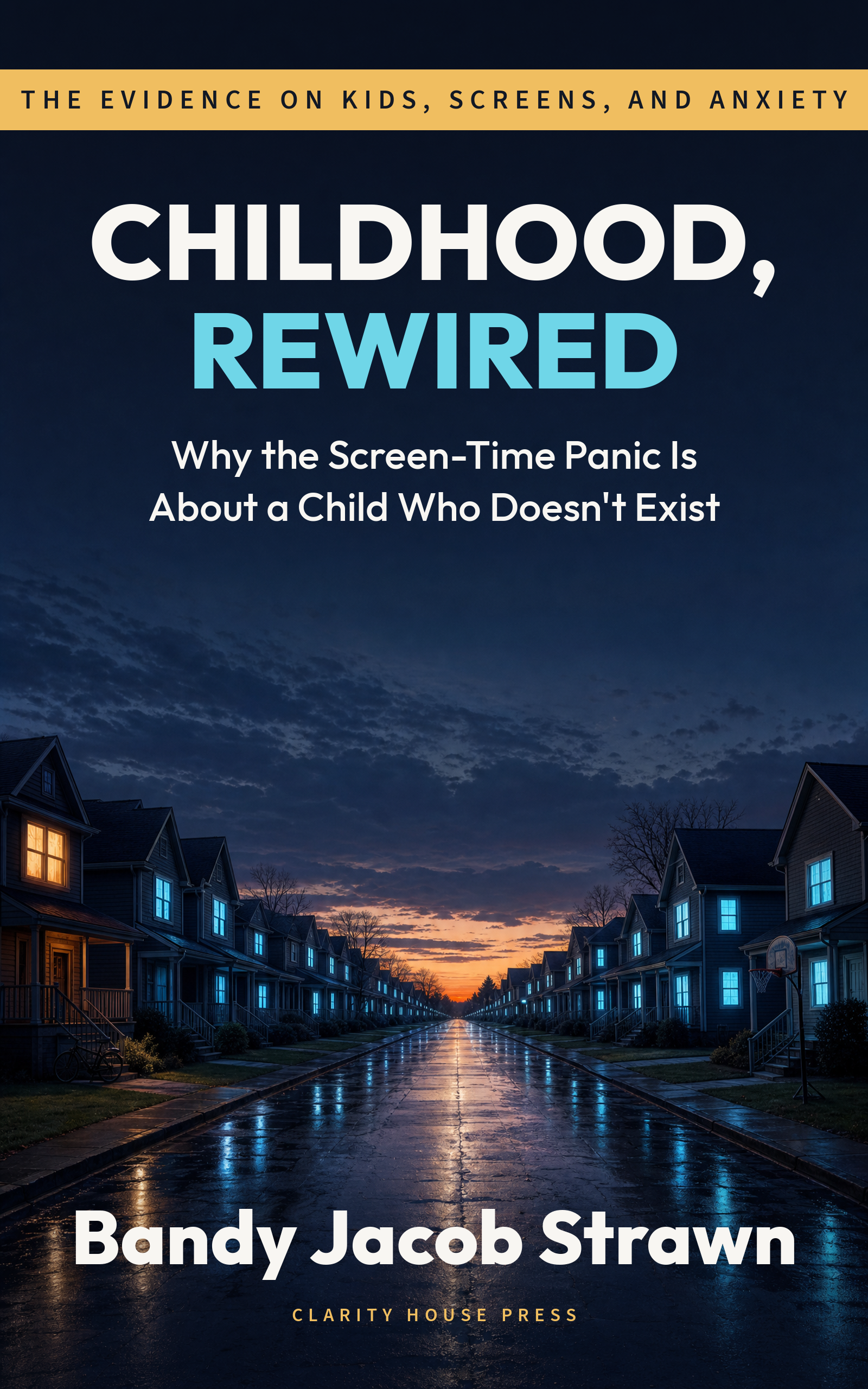
Childhood, Rewired
Why the Screen-Time Panic Is About a Child Who Doesn't Exist

by
Adolescent distress rose after 2012 — that part is not in question. Whether screens caused it is still open, and the answer depends on which child you mean. Childhood, Rewired weighs the evidence on attention, anxiety, sleep, play, friendship and identity, and marks every verdict for the confidence it has earned. A few of its chapters side with the worry almost entirely.
Charged today · delivered to your inbox on November 11, 2026

Where this book begins
The average teenager everyone argues about does not exist.
Picture two thirteen-year-olds in the same grade at the same school. One uses her phone about as much as the other, and it is a place she talks to her friends. The other is already anxious, already sleeping badly, and the same hours land on her very differently. Their average is a third child who does not exist, and every headline about “what screens do to teenagers” is a statement about that third child.
- chapters
- 13chapters
- domains weighed
- 7domains weighed
- evidence figures
- 22evidence figures
About This Book
The question underneath the worry
What actually happened — and how worried should I really be?
That is the question this book was written to answer, in the voice you would want from the fairest person you know: unafraid to say “this fear is fully justified,” equally unafraid to say “this one is overblown, and here’s why.”
The rise in adolescent distress after 2012 is real. It shows up in self-reports, diagnostic interviews, hospital records and death certificates — including the death-certificate data no reporting artifact can inflate. What caused it is a different question, and it is unsettled.
The phone arrived to a yard that was already empty.
Much of what we now mourn as lost childhood — the unsupervised roaming, the long boredom, the hours of free play with no adult in sight — was already gone before the first child held a smartphone.
Domain by domain, the book puts the strongest version of the worry on the table, then the strongest evidence for it, then the strongest evidence against it, and weighs them in the open.
What the book gives you
- Built on a 154-source bibliography and 190 chapter notes you can check yourself
- A chapter on what the evidence still cannot tell us, and one on how to decide anyway
- Each verdict marked well-established, contested, overstated or mixed, under a rule published in Appendix A
- The strongest case for and against the popular claim, in every domain chapter
- 22 evidence figures, each drawn from its source data, plus The Evidence at a Glance appendix
- By an author from the last analog childhood, who then went and checked the data
Four marks, and the rule for earning each
Every domain in this book ends in a verdict, and every verdict carries one of four marks that says how much confidence the evidence has earned. None of the four is a vote for just panic or just relax.
- Well-established
- real, replicated, and large enough to take seriously
- Contested
- careful people read the same evidence and disagree in good faith
- Overstated
- the popular telling has outrun a real but smaller kernel, which is always granted
- Mixed
- a claim that bundles a solid part with an inflated one, pulled apart and marked piece by piece
The rule is written down in Appendix A; the rulings are gathered in Appendix B, The Evidence at a Glance.
Seven domains, seven verdicts
- Chapter 4
Attention
“Screens shrank kids' attention span to fewer seconds than a goldfish gets.”
overstated, with a real kernel
- Chapter 5
Anxiety & the Mental-Health Question
“Smartphones and social media caused a teen mental-health crisis.”
contested — the live battleground
- Chapter 6
Sleep
“Screens are wrecking kids' sleep, and blue light is the culprit — so buy the glasses.”
mixed
- Chapter 7
Play & Independence
“Screens ended outdoor, independent childhood.”
mixed — real loss, misattributed cause
- Chapter 8
Friendship & Social Development
“Screens made this generation lonely and unsocialized.”
contested
- Chapter 9
Identity & Self-Presentation
“Social media is wrecking all teenagers' sense of self.”
mixed
- Chapter 10
The Unequal Rewrite
“Screens either harm all kids or harm none — pick a side.”
well-established that averages mislead; contested on which moderator, and how big
In this field, public confidence runs in almost exactly the inverse order of the evidence. What we are surest about is what we know least. What we know best is what nobody is shouting.
Childhood, Rewired
Charged today · delivered to your inbox on November 11, 2026
Who this is for
For readers who would rather weigh it than be told.
“I would count this book a success not if you finished it agreeing with my verdicts, but if you finished it able to tell, on your own, when a claim about this subject is carrying more weight than its evidence can bear.”
- Parents raising children in the smartphone era
- Teachers, pediatric clinicians and mental-health professionals
- Readers of Haidt's The Anxious Generation, Twenge's iGen, and Hari's Stolen Focus
- Anyone who would rather have the evidence than the slogan
- Policymakers and media-literacy advocates
This book discusses developmental, psychological, and public-health research for general educational purposes. It is not a substitute for professional medical or mental-health advice; for concerns about a specific child, consult a qualified clinician.
Advance reader copies
Read the whole book free, before it’s published.
Complete advance ebooks go to approved readers before the November 11, 2026 release: parents, teachers, clinicians, researchers, journalists and people who work in policy. We read every application ourselves.
Reasonable precautions
Three things the evidence already supports
Before the long weighing, the Introduction puts three things on the table that rest on the cleaner end of the evidence — not a program, and not a checklist to be anxious about completing.
The device out of the bedroom at night
The object, in the room, while a child sleeps. Not “less screen time” in the vague, guilt-soaked sense — that one concrete thing. The association between bedtime devices and lost sleep is among the most replicated findings in this book.
No hurry to hand the youngest children an always-connected phone
A posture more than a rule. Whatever risk exists concentrates earliest and heaviest in early adolescence, and time is the one thing delay reliably buys. The book marks delay contested as a cure — this is precaution, not treatment.
What a child does matters more than how long
A single distinction worth more than any rule: what a child does on a screen matters far more than how many hours the screen is on. A tense, comparison-soaked scroll and a video call with a grandparent are not the same hour.
Each of these is a reasonable precaution backed by the better evidence, not a proven cure.
How it differs from what you have already read
Unlike the alarm…
Haidt and Twenge read the dose-response pattern as evidence of real, substantial, girls-concentrated harm the skeptics averaged away. This book grants the large rise in distress is real — and marks the cause contested, because the field has not resolved it.
Unlike the skeptics…
Odgers, Orben and Przybylski read the small average and the analytic flexibility of the field as evidence the strong causal claim outruns the data. This book grants the small average — and refuses to read it as “no child is affected,” because the average is exactly where the action hides.
Unlike a referee…
Both camps are serious and both are built from real evidence, so each is staged at full strength. Balance here does not mean splitting every difference and calling it fairness — rigor is applied symmetrically and the evidence falls where it falls. Sometimes the worry wins decisively. Sometimes the skeptics do.
Frequently asked questions
Is this book pro-screen or anti-screen?
Neither. Its one sentence: the change to childhood is real and large — and the dominant public story about it is part true, part overstated, and part simply wrong. It refuses both “just panic” and “just relax.”
Does it say smartphones caused the teen mental-health crisis?
No, and it does not say they didn't. The post-2012 rise in adolescent distress is real and large; whether smartphones and social media are a primary cause, one contributor among several, or largely coincident is genuinely contested. Both camps get their strongest case, and neither gets to claim the book.
What does “the average teenager does not exist” mean?
The population average blends large effects on some children with negligible effects on most, so for any particular child the average is very nearly the wrong number to consult. The book calls that figure the phantom-average child.
Does it tell me what to do?
It tells you what it found, marks each finding for the confidence the evidence earned, names a few precautions the better evidence supports, and hands the last decision — about a particular child — to the person who can see where that child sits.
How does it rate its own confidence?
Every domain verdict carries one of four marks — well-established, contested, overstated or mixed — under a rule published in Appendix A and applied row by row in Appendix B, so any verdict in the book can be audited against its own standard.
How does this compare to The Anxious Generation?
It is not a rebuttal of it. It stages the case Haidt and Twenge make and the case Odgers, Orben and Przybylski make, each at full strength, and declines to declare a winner on the mental-health cause, because the evidence does not produce one. It then runs the same test on six other domains, whose verdicts range from overstated to well-established.
Who is it for besides parents?
Educators, pediatric and mental-health professionals, school leaders deciding on phone policy, and anyone who would rather have the evidence than the slogan.
When and how do I get it?
The ebook is available to pre-order direct from the publisher for $9.99 in Kindle, EPUB and PDF. Your card is charged today and the book lands in your inbox on November 11, 2026. Print editions follow at release.
Decide for yourself.
Seven verdicts, four marks, and 154 sources you can check.
Ebook pre-order open now — print editions follow at release.
Pre-order
Releases November 11, 2026Pre-order the ebook — $9.99
Kindle, EPUB and PDF — nothing to track or remember.
Charged today · delivered to your inbox on November 11, 2026
Spread the Word
Know someone weighing the screen-time question?
Share this page with a parent, teacher or clinician who is weighing it too.