Please read our important disclaimers before using this content
The Custody Process: From Emergency Relief to Final Orders
Custody doesn't happen all at once. Instead, it unfolds through multiple stages, each with different purposes, timelines, and strategic opportunities:
Temporary Orders (Early Stage - Days to Weeks)
- Filed early in the divorce process to address immediate needs
- Emergency protective orders, temporary custody, temporary support
- Much lower evidentiary bar than final orders
- Purpose: Preserve status quo and prevent harm while case proceeds
Preliminary Hearings/Conferences (Early to Mid-Stage - Weeks to Months)
- Court reviews temporary orders and makes interim adjustments
- Parties present evidence about temporary arrangement effectiveness
- Mediations may be required
- Purpose: Address problems with initial temporary orders before trial
Final Judgment (Late Stage - Months to Years)
- After full litigation or settlement, court issues permanent custody order
- Based on full evidence, expert evaluations, trial testimony
- Higher evidentiary standard
- Difficult to modify without showing substantial change in circumstances
Understanding the Challenge
High-conflict custody cases differ fundamentally from standard divorce proceedings. The same rules apply, but the dynamics—ongoing abuse, manipulation, and parental alienation—create unique challenges that require specialized strategies.
Understanding the legal framework, court procedures, and evidence requirements helps you navigate this process more effectively while protecting yourself and your children. The documentation you build throughout this process is fundamental — what to document and how to present it for court is essential reading before any hearing.
Key Concepts
The Standard of Proof
Family court operates on "preponderance of evidence"—more likely than not (51%). 1 This is lower than criminal court's "beyond reasonable doubt" but still requires documented, specific evidence.
Best Interests Factors
Courts weigh multiple factors including: 2
- Each parent's ability to provide stability
- History of domestic violence or abuse
- Parent-child relationship quality
- Each parent's willingness to facilitate the other's relationship
- Child's adjustment to home, school, community
When a parent has committed domestic violence, courts in approximately half of U.S. states presume this is detrimental to the child and contrary to the child's best interests. 3 In these jurisdictions, the abusive parent must rebut this presumption by preponderance of evidence to gain custody. When testifying about these dynamics, how you present evidence matters enormously — see how to testify credibly in custody court for specific preparation guidance.
Real-World Examples
Jennifer's case: When Jennifer filed for divorce citing domestic violence, her ex-husband immediately claimed parental alienation and accused her of making false allegations. Her attorney helped her document specific incidents, obtain protective orders, and present clear evidence that resulted in supervised visitation for her ex. This reflects research showing that courts' decisions in domestic violence custody cases depend heavily on evaluator knowledge and beliefs about the underlying causes. 4
David's situation: David's ex-wife repeatedly violated the parenting plan, canceling his weekends and ignoring court orders. After documenting six months of violations the way attorneys recommend, his attorney filed for contempt. The court imposed sanctions and modified custody to reduce the ex-wife's ability to interfere. Post-separation abuse is a recognized risk pattern, as research indicates the risk of serious injury or death is highest in the days and weeks following separation. 5
NOTE ON HOTLINE NUMBERS: Phone numbers for crisis hotlines, legal aid, and support services are provided as a resource. These numbers are current as of publication but may change. Please verify hotline numbers are still active before relying on them. For the National Domestic Violence Hotline, visit thehotline.org for current contact information.
Resources
Legal and Family Court Support:
- American Bar Association Family Law Section - Find family law attorneys
- Legal Services Corporation - Find free legal aid
- National Domestic Violence Hotline - 1-800-799-7233 (SAFE)
- National Parent Helpline - 1-855-427-2736 for parenting support
Mental Health and Support:
- Psychology Today Therapist Finder - Find family therapists
- National Alliance on Mental Illness (NAMI) - Mental health education
- SAMHSA National Helpline - 1-800-662-4357 (24/7)
Crisis Support:
- 988 Suicide & Crisis Lifeline - Call or text 988 (24/7)
- Crisis Text Line - Text HOME to 741741
Key Takeaways
- Custody is decided in stages: Temporary orders set the status quo early; final orders require full evidence and carry lasting weight — the stage you're in determines your strategy
- Temporary orders matter more than they seem: Because courts are reluctant to disrupt established arrangements, the temporary order often becomes a template for the final order
- "Best interests" is multi-factor: Courts weigh stability, abuse history, parent-child relationships, and each parent's willingness to support the other's relationship — not any single factor
- Preponderance of evidence is your standard: More likely than not (51%) — documented, specific evidence is what moves courts
- Professional support matters: Experienced family law attorneys and trauma-informed therapists significantly improve outcomes in high-conflict cases
- Document from day one: The evidence you build throughout this process is the foundation for every hearing that follows
Your Next Steps
-
Immediately: Begin documenting everything. Date, time, what happened, any witnesses. Save all texts, emails, and voicemails.
-
This week: Schedule consultations with 2-3 family law attorneys who handle high-conflict cases. Ask about their experience with domestic violence, parental alienation, and complex custody litigation.
-
This month: Organize your evidence into categories: safety concerns, parenting capability, co-parent's interference, communication examples. Create both chronological and thematic organization.
-
Ongoing: Communicate with your co-parent only through documented channels (email, co-parenting app). Keep communication brief, informative, friendly, and firm (BIFF method).
Additional Resources
- Legal aid: LawHelp.org for free/low-cost legal assistance by state
- Domestic violence support: National Domestic Violence Hotline 1-800-799-7233
- Documentation apps: TalkingParents, OurFamilyWizard, AppClose for court-admissible communication records
- Books: Splitting: Protecting Yourself While Divorcing Someone with Borderline or Narcissistic Personality Disorder by Bill Eddy
References
- Cornell Law School, Legal Information Institute. (n.d.). Preponderance of the evidence. https://www.law.cornell.edu/wex/preponderance_of_the_evidence ↩
- Moon, Lee, Chung, & Kwack (2020). Custody Evaluation in High-conflict Situations Focused on Domestic Violence and Parental Alienation Syndrome.. Soa--ch'ongsonyon chongsin uihak = Journal of child & adolescent psychiatry. https://pmc.ncbi.nlm.nih.gov/articles/PMC7289472/ ↩
- Campbell, J. C., Sharps, P., & Glass, N. E. (2001). Risk assessment for intimate partner violence. In The Handbook of Injury and Violence Prevention (pp. 409-427). Springer Publishing. Referenced in Child Custody and Visitation Decisions in Domestic Violence Cases: Legal Trends, Risk Factors, and Safety Concerns (Revised 2007). National Resource Center on Domestic Violence. https://vawnet.org/material/child-custody-and-visitation-decisions-domestic-violence-cases-legal-trends-risk-factors ↩
- Stark, D. P., & Choplin, J. M. (2011). Properly accounting for domestic violence in child custody cases: Applying a research-based approach. Journal of Child Custody, 8(3), 220-254. https://repository.law.umich.edu/mjgl/vol26/iss1/2/ ↩
- Campbell, J. C., Webster, D., Koziol-McLain, J., Block, C., Campbell, D., Curry, M. A., ... & Laughon, K. (2003). Risk factors for femicide in abusive relationships: Results from a multisite case control study. American Journal of Public Health, 93(7), 1089-1097. U.S. Department of Justice, Office on Violence Against Women. Child Custody Decisions in Cases Involving Domestic Violence: Guiding Principles. https://www.justice.gov/archives/ovw/blog/child-custody-decisions-cases-involving-domestic-violence-guiding-principles ↩
- Jaffe, P. G., Johnston, J. R., Crooks, C. V., & Bala, N. (2008). Custody disputes involving allegations of domestic and child abuse. Journal of Child Custody, 5(3-4), 199-218. https://pmc.ncbi.nlm.nih.gov/articles/PMC1448371/ ↩
- Buchanan, A., Hunt, C., Bretherton, H., & Bream, V. (2001). Families in conflict: Perspectives of children and parents on the Family Court process. Family Court Review, 39(4), 441-455. https://pmc.ncbi.nlm.nih.gov/articles/PMC7986964/ ↩
- Birnbaum, R., & Bala, N. (2010). Mandatory parent education programs: Are they effective? Family Court Review, 48(2), 331-345. https://pmc.ncbi.nlm.nih.gov/articles/PMC7289476/ ↩
- O'Hara, Sandler, Wolchik, Tein, & Rhodes (2019). Parenting time, parenting quality, interparental conflict, and mental health problems of children in high-conflict divorce.. Journal of family psychology : JFP : journal of the Division of Family Psychology of the American Psychological Association (Division 43). https://pmc.ncbi.nlm.nih.gov/articles/PMC6880406/ ↩
- California Judicial Council. (2024). Parental Alienation Syndrome and Parental Alienation: A Research Review. Judicial Council of California. https://courts.ca.gov/sites/default/files/courts/default/2024-12/btb25-precondv-11.pdf ↩
Recommended Reading
From Clarity House Press — plus trusted books for deeper understanding


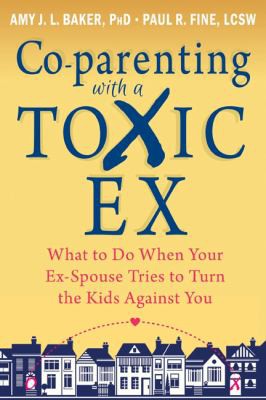
Co-Parenting with a Toxic Ex
Amy J. L. Baker, PhD & Paul R. Fine, LCSW
Evidence-based strategies when your ex tries to turn kids against you. Parental alienation prevention.

BIFF for CoParent Communication
Bill Eddy, Annette Burns & Kevin Chafin
Specifically designed for co-parent communication with guides for difficult texts and emails.
As an Amazon Associate, Clarity House Press earns from qualifying purchases. Your price is never affected.
Found this helpful?
Share it with someone who might need it.
About the Author

Clarity House Press
Editorial Team
The editorial team at Clarity House Press curates and publishes evidence-based content on narcissistic abuse recovery, high-conflict divorce, and healing. Our content is informed by research, survivor experiences, and established trauma-informed approaches.
View all posts by Clarity House Press →Published by Clarity House Press Editorial Team